
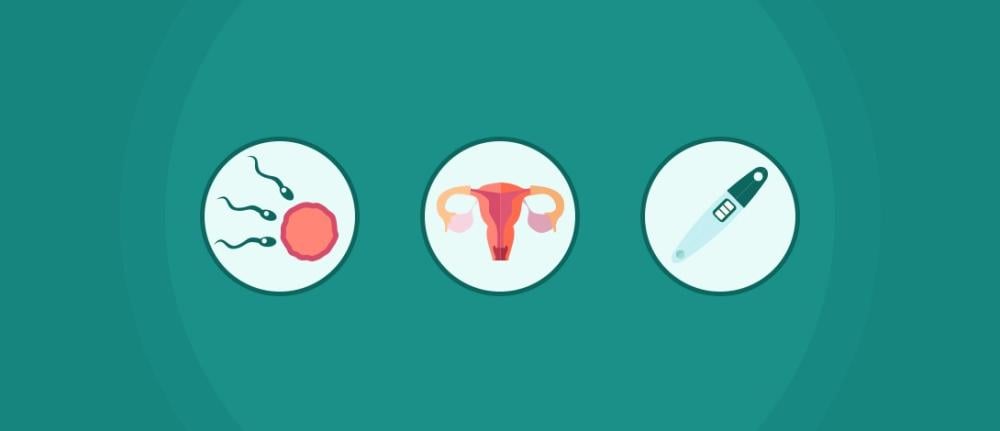
Do you know how pregnancy occurs inside the body? And when your chances of getting pregnant increase and when they decrease !
If you are getting married soon or are newly married, don't miss reading this article and learning everything about getting pregnant.
Overview
We all know that the purpose of the menstrual cycle is to prepare a girl’s body for pregnancy upon marriage. The cycle is a natural and healthy process within the reproductive cycle and the menstrual cycle as a whole, which also includes the ovulation process, which is intrinsically linked to pregnancy.
Therefore, knowing how pregnancy occurs inside the body begins first with understanding the ovulation cycle, because pregnancy simply occurs as a result of the meeting of sperm and egg during intercourse. Therefore, ovulation disorder hinders pregnancy. In order to make the matter clearer, we will mention in the following paragraph how pregnancy occurs step by step.
How does pregnancy occur inside the body?
1 - Ovulation
Ovulation is the process during which a mature egg is released from the ovary. It usually occurs in the middle of the menstrual cycle, about two weeks after the first day of the previous menstrual period. As we mentioned, it is the basic process for conception, and during this time a woman is more fertile than at any other time. There are a number of symptoms that occur during the time of ovulation, such as the appearance of white or clear discharge without itching, odor, or a change in body temperature from the norm.
2 - Movement of the egg
After the egg is released from the ovary, it begins to move to the fallopian tube, which is the tube that connects the ovary to the uterus, and the egg remains there for 12 to 24 hours, in preparation for fertilization.
3 - Fertilization
Fertilization occurs through sperm, which can remain inside the woman's reproductive system for 5 days. If the sperm manages to fertilize the egg at that stage, the outer surface of the egg changes to prevent any other sperm from reaching it. At that stage, the baby's genes have formed, and the pregnancy journey begins.
4 - Division
After the mature egg is successfully fertilized, it begins to divide into different cells and travels from the fallopian tube to the uterus. This happens after about 4 days. There is a rare condition known as "ectopic pregnancy," in which the egg remains in the fallopian tube.
When the egg travels to the uterus, it begins to implant in the uterine wall.
5 - Pregnancy hormone
After the previous processes are completed, the body begins to secrete the pregnancy hormone HCG, which appears in the blood after about a week and in the urine after about 14 days.
If the next menstrual period is not due, the woman will begin to undergo a pregnancy test, either at home or in a laboratory, to confirm that pregnancy has occurred.
When is the chance of getting pregnant highest?
Certainly, the chance increases during ovulation. Therefore, based on what was mentioned above, if the couple wants to conceive, they should have marital relations throughout the entire week of ovulation, either daily or every other day.
When does the chance of getting pregnant decrease?
There is what is known as the safe period, which is the period during which the chance of pregnancy becomes weak even if intercourse takes place. It is classified as all the days that are completely away from the week of ovulation, and it is often before the next menstrual period.
If you have doubts about whether you are actually pregnant or not, there are some early symptoms that indicate pregnancy, which are:
- Absence of menstruation
- body temperature
- Breast tenderness and swelling
- Frequent urination
- nausea
- fatigue